
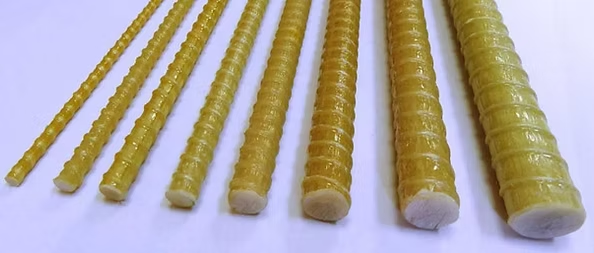
The Need Reinforced Concrete is commonly used building material for the construction of several types of structures. As concrete is strong in compression and weak in tensile, steel rebars are usually provided as an effective and cost-efficient reinforcement to resist the tensile stresses. However, the following factors may lead to the cracking of the concrete and corrosion of the steel rebars: insufficient or porous concrete cover, poor workmanship, and aggressive environmental . For example, in the USA alone almost 40% of bridges are structurally deficient or functionally obsolete, and this percentage may increase, according to the Federal Highway Administration (Griffiths 2000). The subject of corrosion of rebars has been studied for several years and a few solutions have been suggested. One such suggestion is the replacement of steel bars with FRP (Fiber Reinforced Polymer) rebars.
Thus, the use of FRP rebars in these applications reduces the life cycle costs, thereby enhancing service life and safety. The Floodway Bridge (Canada) is one of the largest bridges constructed using FRP rebars. In addition, The Florida Keys Bridges (U.S.) is one of the prominent examples where CFRP rebars are used for the strengthening of structurally deficient bridges. Many such projects are executed in the U.S. and Canada where FRP rebars is used as concrete structure reinforcements.
The global FRP rebars market was worth USD 48.00 Million in 2015, registering a CAGR of 11.4% between 2016 and 2021. In this study, 2014 has been considered as the historical year, 2015 as the base year and 2016-2021 as forecast years for estimating marker size of FRP rebars. In this research report, the market for FRP rebars has been categorized based on resin type, fiber type, application, and region and forecasts revenue growth and analysis of trends on each of the submarkets.
Different secondary sources such as company websites, encyclopedias, directories, and databases have been used to identify and collect information that is useful for this extensive commercial study of the global FRP rebars market. The primary sources, which include experts from related industries, have been interviewed to verify and collect critical information as well as to assess the future prospects of the market. The top-down approach has been implemented to validate the market size, in terms of value and volume. With the data triangulation procedure and validation of data through primaries, the exact values of the overall parent market size and individual market sizes have been determined and confirmed in this study.
Glass fiber composites: The largest fiber type for FRP rebars
Glass is the leading type of reinforcement fibers used for various applications, such as mining, highways, roads, & buildings construction, and wastewater treatment plants. This growth can be attributed to its superior properties such as strength, flexibility, durability, stability, lightweight, as well as resistance to heat, temperature, and moisture. North America is the biggest market for glass fiber composite rebars, while the ME&A is the fastest-growing market.
Some of the key global players prevailing in the FRP rebar market are Hughes Brothers (U.S.), Pultrall Inc. (Canada), Marshall Composites Technologies LLC. (U.S.), Pultron Composites (New Zealand), Armastek (Russia), BP Composites Ltd. (Canada), Dextra Group (Thailand), Firep International AG (Switzerland), A.T.P. Avanzate Tecnologie Plastiche Srl (Italy), International Grating Inc. (U.A.E.), Sireg S.p.A (Italy), among others.
 Telefone: (19) 99170-5975
 E-mail: axfiber@axfiber.com.br
 Endereço: Avenida do Comércio, 125
Campos Gerais - MG
Endereço: Avenida do Comércio, 125
Campos Gerais - MG